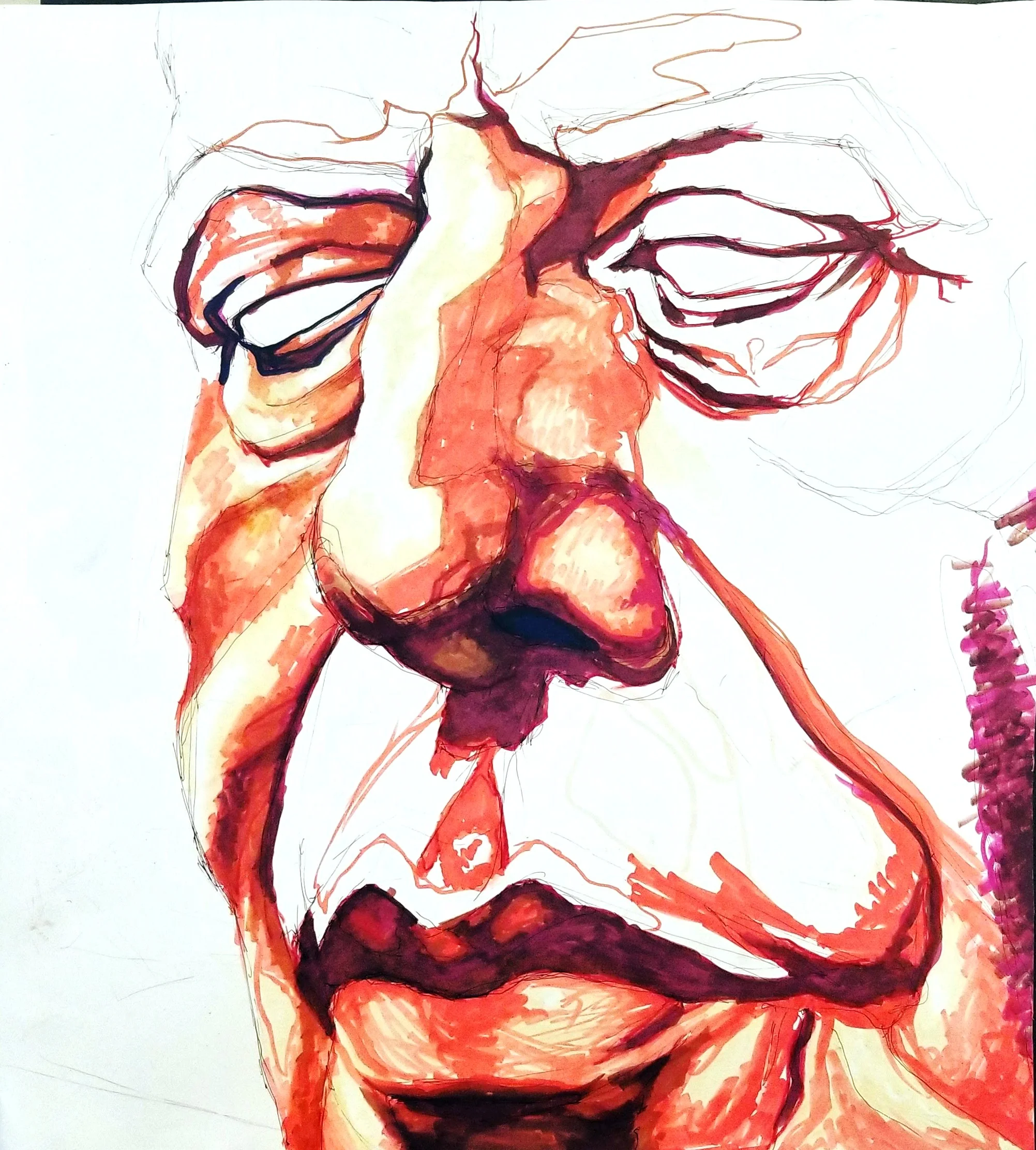
Monster
Humans are defined by our fear of the unknown, and by our gnawing compulsion to understand it. It winks at us through the sublimity of nature, and bucks like a beast of unimaginable strength when we attempt to understand and harness its mysterious power. Peel back the paper veneer and enter the living heart of The Odyssey by Homer and Frankenstein by Mary Shelley.
Just as the men of these master works attempt to capture and conquer nature’s elusive essence, the texts also strive to “unveil the face of nature” while acknowledging that “her immortal lineaments are still a wonder and a mystery,” (Shelley 8). Victor’s narration in Frankenstein is rife with descriptions of appearance, revealing his unwavering belief that image is representative of its inner being. Shelley intends to disprove this belief through Victor’s ultimate failure. Conversely, Homer enforces this concept when describing the Cyclops, a monster who symbolizes wilderness, “he seemed no man at all… rather a shaggy mountain,” (150). These tales of testosterone driven expeditions also serve to divulge the friction and harmony between masculine and feminine. The Frankenstein quote above refers to nature as female, with men chasing glory through the exploration of her secrets. These texts use the motif of “monster versus man” to explore the tensions between humans and the natural world, between outer appearance and inner constitution, and between men and women.
The voyages of Frankenstein and The Odyssey illuminate the relationship between humanity and the natural world we exist in. The protagonists both seek to conquer nature, but their motivations and strategies differ. In The Odyssey, the hero’s goal is to survive in order to return home. The journey in Frankenstein is more allegorical than literal, though Shelley does open the story with a cold and cruel journey to the North Pole. Our first two narrators, Walton and Victor, have parallel goals. They are both men born of privilege, with a sense of inferiority, that fuels their hunger for the pride of purpose. To that end they use the means of scientific study. Odysseus has no inclination for some great end other than a return to home and family, because he has already conquered those masculine motives through the glory of battle.
In his journey, Odysseus must overcome many beasts that are symbolic of the ferocious landscape he traverses. Scylla and Charybdis are representative of unknown forces, as is described by the goddess Circe, “Horror, and pain, and chaos; there is no fighting her, no power can fight her, all that avails is flight,” (Homer 213). Odysseus barely clings to survival, only by using his wits and manipulating his men by omitting that they are likely to die. If he hadn’t acted shrewdly the female monsters probably would have killed them all in that moment. “I told them nothing, as they could do nothing,” (217). Like the sea, the beasts cannot be conquered, only endured.
Unlike the beasts of sea, Odysseus is capable of conquering the beasts of land. His encounter on shore with the rough, gritty Cyclopes exhibits Homer’s view that human manipulation of land is superior to the wilderness. The wild Cyclopes appear more like humans than the female monsters – “Giants, louts, without a law to bless them,” – but unlike humans they do not cultivate the land, “leaving the fruitage of the earth in mystery,” (148). For vegetation they forage just the same as the Frankenstein monster. The Cyclopes also do not fear or heed the gods, they have only a primitive grip of human ways through husbandry and fire, and they don’t have any form of government, even tribal. These things further define them as savage beasts and not superior men who have complicated systems of religion, society, and horticulture. However, Homer ascribes great qualities to the monsters. They express the spectacular might and chaos attributed to natural forces. Homer’s opinion of man’s dominance over nature is enforced in the end of this tale, when Odysseus’s intellectual cunning trumps the untamed strength of the Cyclops.
Though Frankenstein also upholds the splendor of humankind, it differs from The Odyssey in its divulgence of nature as a sublime and mysterious enigma that should not be harnessed by humans. Frankenstein is a warning against the pursuit of knowledge as an effort to master the forces of nature. Victor sets out to “pour a torrent of light into our dark world… many happy excellent natures would owe their being to me,” but his attempt at mastery over the intangible backfires explosively (Shelley 20). Victor forges his own agonizing destiny, a life of suffering for his creation, and the destruction of his loved ones all in one cataclysmic act of self-importance and superficiality. Though Victor’s self-importance drove him to spend many long and painstaking months engineering his monster, it only took one instant for his superficial abandonment of the physically appalling beast to seal both of their destinies. While warning against only looking skin-deep, Shelley also imparts that forces of nature – like the cause of life – are volatile and unpredictable. In this way Homer and Shelley can agree, even though Homer believes that nature can and should be tamed.
Homer makes no effort to reveal a complexity to the inner workings of his beasts. We take their nature at face value, opposite of the Frankenstein monster. By allowing the monster to speak his mind and express his narrative, Shelley shows that just because he appears to be a repugnant brute doesn’t mean that he is. Homer cares to let us know that the Cyclops is “reared in solitude,” (150) but does not draw deep psychological conclusions about his solitude the way that Shelley does with her motherless monster. His soul is inherently loving and kind. He would be compassionate if he didn’t have to suffer in absolute isolation, orphaned and despised by his creator, viewed as a fearful aberration to mankind.
The way that Victor narrates clearly underlines his obsession with the visual perception of living things as a representation of their spirit. The word “countenance,” defined as “the face as an indication of mood, emotion, or character,” is just one example of many words that appear regularly in the text (“countenance”). The vocabulary of Frankenstein is effective in its repetition because it stretches every limit of each word’s meaning. I will provide a quote from Shelley that illustrates how as you move linearly through the text the poetic use of diction expresses concept and fabricates an interwoven pattern of understanding. “The immense mountains… spoke of a power mighty as Omnipotence – that which had created and ruled the elements, here displayed in their most terrific guise,” (54). Words like “Omnipotent, mighty, rule,” express Victor’s obsession with power. In the quote and his use of words like “guise,” Victor again shares his belief that how he sees the world is direct evidence of its constitution.
Appearance and physicality are part of what make us human, but behavior, intelligence, talent, and personality are more important qualities for indicating true character. When I was a humongous teenager in agonizing pain over my “otherness,” I often wished I could look plain so that people would interact with me based on the profound soul within my prodigious body, instead of brutally jeering at me because I was different. Now I realize that, as a woman in this current culture, it is impossible to escape the judgment of appearance as a mark of worth. On the bus this morning I overheard a conversation between two men who were discussing a play. They were talking about the female actors. The first comment about each actor was on her desirability, after which they might speak of her talent or of the nature of her character in comparison with her appearance.
Conversely, the customary way to determine a man’s worth is based on talent and action before beauty, as is exemplified by Odysseus. Though his beauty and sexual prowess are displayed in the text, his worth is intrinsically defined by his actions. It’s not to say that in contemporary culture men don’t get held to dehumanizing standards, but they are not the same beauty standards that repress women. Odysseus is a pretty good example of male standards. Unfortunately, the dangerous expectation of ideal masculine traits often give way to feelings of inadequacy among men. That is the reason some men feel so uncomfortable around me, strangely it is also a reason that some men are so intoxicated by my unique stature. They believe that my physical presence either intensifies or quells their insecurities. I feel compassion for them, but not the guilt or shame that I once felt as a girl.
It is painfully obvious to me that Victor Frankenstein falls victim to his masculine insecurities, because I’ve had to encounter this phenomenon so often in my life. He was driven by an obsession with power over nature, which is routinely referred to as a feminine entity. He alludes to this often in the text, for instance when he moves from studying outdated and illusionistic natural philosophers to studying modern scientists of the time, “I was required to exchange chimeras of boundless grandeur for realities of little worth,” he explains with contempt (Shelley 14). “Chimera” has multiple meanings, which also illustrates an earlier point I made about Shelley’s magnificent use of diction. A chimera is a mythical she-monster, a deluded fantasy, and “a monster compounded of incongruous parts,” (“chimera”). Not too far ahead Victor finds again his spirit of conquest that in combination with his shallow nature will ultimately be his downfall. He states, “I will pioneer a new way, explore unknown powers, and unfold to the world the deepest mysteries of creation,” (15). Some men who feel inadequate are driven to masculine voyages hoping to harness power. Victor proves Shelley’s point that this is dangerous, and can be a profoundly foolish pursuit.
The Frankenstein monster is a passionate being. The reservoirs of his spirit are filled with intense currents of emotion. When he loves it is fiercely and with his whole heart, and the same is true of his vivid and violent hatred. I found it very curious that throughout the novel Victor searches for the “cause of life,” when the answer to that riddle is a glaringly obvious single word comprised of three letters. Sex. Human reproduction is a union between masculine and feminine in an act of passion and an expression of love, while Victor’s pathological act of creating life was performed in shameful isolation. It was truly a masturbatory act. I won’t speak for Shelley’s opinion, but I do not think that masturbation itself is repugnant and evil. Victor’s masturbatory action was repugnant because it was not in the name of self-love or even simply pleasure, but was for self-righteous pursuit of Omnipotence.
Both of the books I’ve discussed are about expeditions in which the protagonist struggles with monsters. These beasts are a representation of the relationship between humans and natural forces, between masculine and feminine ideals, and between physiognomy and inner spirit. In Frankenstein, Victor attempts to master the natural world using science. In The Odyssey, Odysseus exerts his conquest over the world through combat and survival. Homeric monsters are purely symbolic of the wild and therefore can be judged based on how they appear, but Shelley provides a beautiful complexity to her visually hideous beast. He serves as a poignant reminder that something, which appears horrible, may actually contain a lovely soul. In the same frame of mind, a beautiful woman may be made-up of a rotten composition. But in reality the lesson isn’t so black and white because humans are infinitely complex. Your personality, peering out from your countenance, interprets the biased judgments of others as a reflection of yourself, and that alters your identity. I have experienced this often as a human being with certain idiosyncrasies, feelings, and virtues of talent that are invisible in the face of the emotional response that my physical presence inspires in others. I see a distorted reflection in the reactions people have to my striking appearance, and each interaction actually augments my character. We are all affecting the malleable definitions of one another.
Works cited:
“chimera.” Merriam-Webster.com. 2013. http://www.merriam-webster.com/dictionary/chimera (12 May 2013).
“countenance.” Merriam-Webster.com. 2013. http://www.merriam-webster.com/dictionary/countenance (12 May 2013).
Homer. The Odyssey. Trans. Robert Fitzgerald. New York: Farrar, Straus and Giroux, 1998. Print.
Shelley, Mary W. Frankenstein. Clayton: Prestwick House, 2005. Digital file.